Industry & Industrial Establishment Advisory

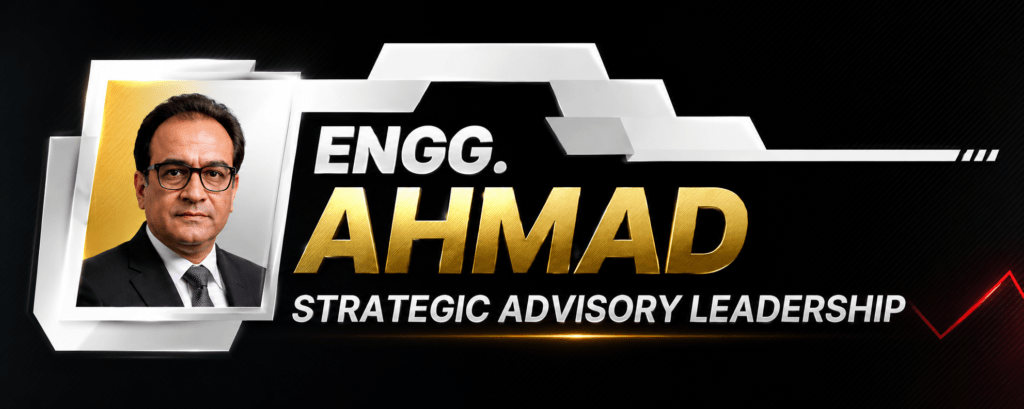
Engg. Ahmad, Chief Advisory Specialist – Elevating Industrial Establishment, Expansion & Governance Advisory

Engg. Ahmad plays a senior advisory role focused on strengthening governance, strategic decision making, and operational effectiveness within industry sectors and industrial establishments (manufacturing, facilities management, industrial services, logistics hubs, and similar environments). The advisor brings industrial groups covering establishment, expansion, independent judgment, rigorous strategy validation, capital planning & risk alignment, banking alignment, governance structure, long-term sustainability, and credibility enhancement tailored to industrial contexts.

Elevating governance, capital & risk, and operational maturity in asset-intensive industries

Section 1

Ideal For:

The Context:

  • Target: Industry and industrial establishments b(manufacturing, facilities management, industrial services, logistics hubs, energy/processing facilities, etc.)

  • Challenge: Governance gaps in asset-heavy environments can lead to slow decisions, unchecked risk, and misaligned capital investments.

  • Opportunity: Independent, sector-aware advisory that aligns governance with capital planning, risk management, and operational priorities to deliver measurable value.

Section 2

The Value Proposition:

  • Independent board-level judgment: Objective challenge on capex-heavy decisions; enhanced decision rationale and traceability.

  • Strategy validation for asset portfolios: Long-horizon asset strategy aligned to demand, technology shifts, and regulatory requirements; proactive course corrections.

  • Capital, liquidity, and risk governance: Integrate capital planning with operational risk, maintenance strategies, and safety/compliance obligations; improve resilience around large projects.

  • Credibility and stakeholder trust: Transparent reporting, ethics/compliance enhancements, and stakeholder engagement that strengthen lender and regulator confidence.

Section 3

Core Capabilities (Selected):

  • Governance design for asset-intensive contexts: Board & committee design; role clarity; independent oversight signaling.

  • Strategic planning for industrial assets: Capex prioritization, capacity planning, scenario-based portfolio decisions.

  • Capital & risk management: Capital policy linked to risk appetite; project-level risk gates; liquidity planning for major programs.

  • Operational governance & safety: Linking governance to EHS, reliability, incident learning, and continuous improvement.

  • Stakeholder engagement and external credibility: ESG/impact reporting aligned to industry norms; thirdparty assurance where relevant.

Section 4

Deliverables (Typical Outputs):

  • Diagnostic & governance health assessment for industrial establishments

  • Independent oversight framework (charters, conflict policies, committee scopes)

  • Strategy validation package (living asset strategy map, capex prioritization, scenario analyses)

  • Capital & risk governance toolkit (risk appetite linkage, project risk reviews, liquidity buffers)

  • Credibility toolkit (disclosures framework, ESG/impact reporting templates, stakeholder engagement plan)

  • Implementation roadmaps with milestones, owners, and dashboards.

Section 5

Engagement Model & Timeline:

  • Phase 1 – Diagnostic: Governance maturity, capital planning processes, risk controls; stakeholder interviews; quick wins.

  • Phase 2 – Design: Governance enhancements, strategy routines, risk-capital playbooks; dashboards and templates.

  • Phase 3 – Implementation: Deploy governance improvements; integrate strategy cadences; embed risk disclosures into project governance.

  • Phase 4 – Sustainment (ongoing): Quarterly reviews; external assessments; continuous improvement loops.

Section 6

Sector-Specific Considerations (Examples)

  • Manufacturing & heavy industry: Capex governance, plant reliability, EHS oversight, maintenance optimization.

  • Logistics & warehousing: Network design, capacity expansion decisions, resilience against disruptions.

  • Energy transition & utilities: Decarbonization roadmaps, asset modernization, regulatory compliance.

  • Industrial services & contractor ecosystems: Subcontractor governance, safety across sites, vendor risk.

Section 7

Metrics & Indicators:

  • Governance: board independence score, frequency of documented dissent, external evaluations

  • Capital & risk: value at risk on major capex, schedule/budget variance, risk-adjusted ROI

  • Operational health: safety, quality, environmental metrics; maintenance effectiveness

  • Credibility: financing terms, regulator feedback, stakeholder sentiment.

Section 8

Why Engage:

  • Faster, higher-quality decisions on large capital programs

  • Clear linkage between strategy, capital deployment, and risk controls

  • Improved resilience to market, supply chain, and regulatory shocks

  • Enhanced credibility with financiers, regulators, employees, and communities.

Section 9

Next Steps:

  • Quick-start proposal: Diagnostic engagement to establish baselines and sector-specific roadmap

  • Proposed timeline: Diagnostic and design, followed by phased implementation

  • Contact: Engg. Ahmad, Chief Advisory Specialist – Industry & Industrial Establishment Advisory.

A p p o i n t m e n t